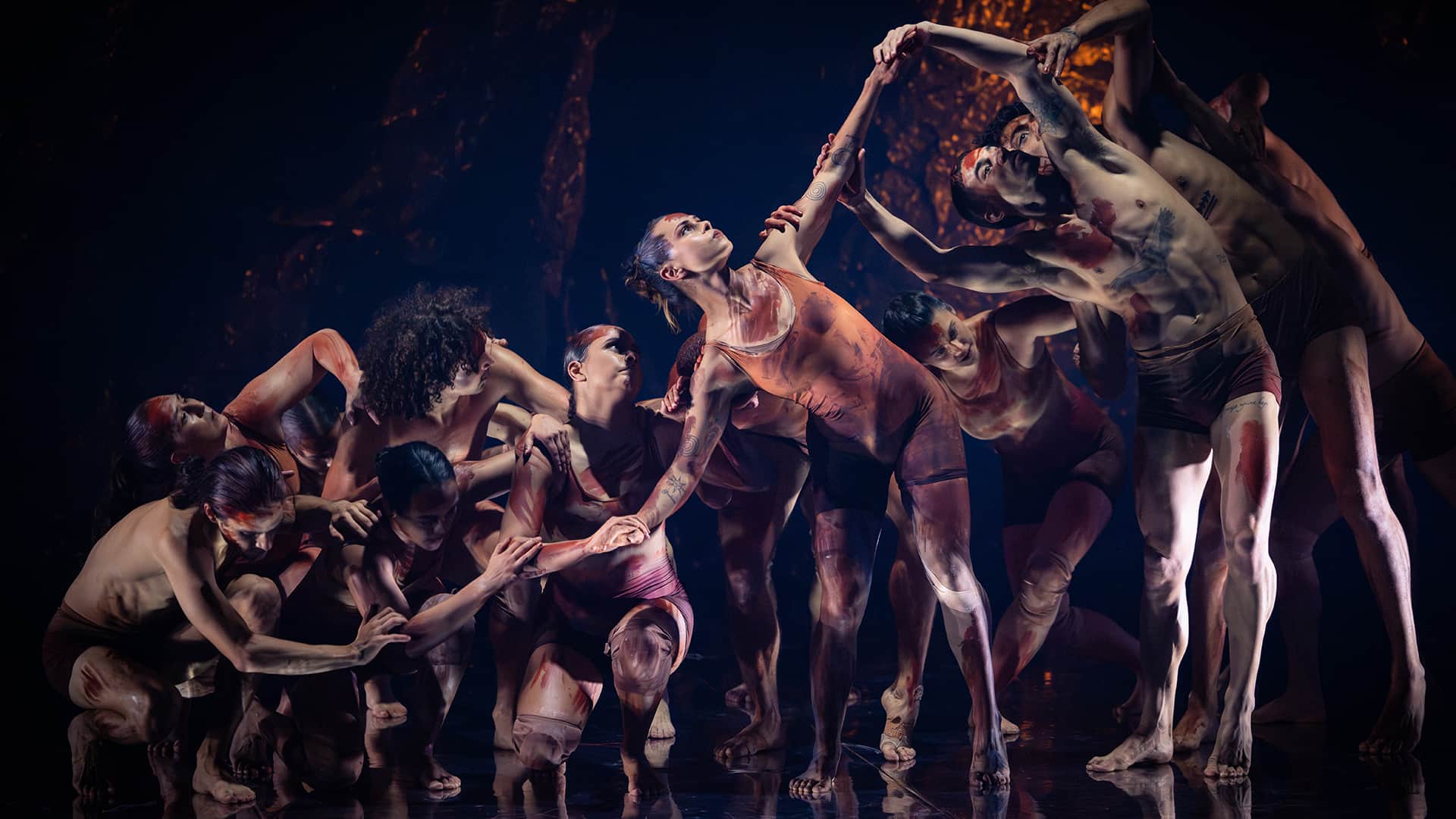
With three choreographers on the bill, Horizon is an ambitious and exciting evolution for Bangarra Dance Theatre. The inclusion of new artists, including designers, into the fold shakes things up and extends the Bangarra aesthetic into some new territory. It also challenges the ensemble in many choreographic directions.
Kulka, by Sani Townson opens the evening and has an abstract, brooding energy, evoking Saibai Island in the Torres Strait. Mixing contemporary design and natural inspiration, it starts with a birth of sorts – Kassidy Waters, carried foetal-like above the heads of the group – and ends with the stars, vast constellations enveloping the stage.
In between the comings and goings, the crocodile god appears in a traditional dance. AV Designer David Bergman layers video seamlessly within the dancers to visualise a puff of smoke that fans out into a crocodile. Live dancers (Lucy May, Bradley Smith and Kallum Goolagong) become said animal in an intertwined, crouching slink within the projection on the floor.
Throughout Kulta, a slanted mirror upstage and distinct lines of light create a kaleidoscopic effect that multiplies the dancers in geometric patterns. More earthy elements come out in the costumes by Clair Parker, bringing a natural element to the modern theatrical design.
Horizon’s second piece, The Light Inside, is a two-parter – Salt Water/Gur/Adabad by Deborah Brown, inspired by the archipelago Zenadth Kes and Fresh Water/Wai Maori by Moss Patterson, inspired by his village, Tokaanu and the rivers and mountains within. (Patterson is artistic director of The New Zealand Dance Company and Bangarra’s first international choreographer.)
Stylistically the two halves have different energies – in a good way. Brown’s is a little softer, more curvaceous and Patterson’s rawer and more aggressive. Yet they work together as a full-length work, mainly because the set design by Elizabeth Gadsby is so consistent throughout.
Dark silhouettes of far-off mountains are simple and moody. Horizontal shafts of light, appearing at ever-changing heights suggest various times of day and seasons. The music composition (Steve Francis and Brendon Boney) brings in natural sounds, highlighted in the rhythms of a waterfall, with set and light creating the illusion of dancers hovering under it.
Across both works, the 16-strong company is always an ensemble. While there are a few solos and duets peppered throughout, Horizon is egalitarian, with the group, not individuals, being the focus. The choreography is without hierarchy and the male/female cultural divisions portrayed in vintage Bangarra programs (in separate men’s and women’s dances) are not so overt here.
Horizon is a marathon of content, with the 20-minute Kulka opening the evening, followed by a 20-minute interval and then the bulk of the evening, The Light Inside, which runs 70 minutes. As one offering, it is almost too much of a good thing to absorb in one sitting.
The Light Inside could be a complete evening on its own. Kulka is a wonderful bonus, but to take in the vastness and imagery of everything on offer in Horizon may require multiple viewings.
Event details
Bangarra Dance Theatre presents
Horizon
Choreography The Light Inside – Deborah Brown and Moss Te Ururangi Patterson with Bangarra Dance Theatre Dancers | Kulka – Sani Townson with Bangarra Dance Theatre Dancers
Venue: Playhouse, Arts Centre Melbourne VIC
Dates: 28 August – 7 September 2024
Tickets: $119 – $59
Bookings: www.artscentremelbourne.com.au